Our Qwen3-TTS engine was written for an H100, and on a GB10 it ran into a different limit, which was memory. The GB10 shares 273 GB/s of LPDDR5x between its CPU and its Blackwell GPU, and every decode step streams the weights through it, so a BF16 step took 28.3 ms to produce a frame that lasts 80 ms. That leaves room for one listener but not for many, and the question became how few bytes a step could get away with reading.
The engine that came out of it generates 3.1× the audio of vLLM-Omni, the vLLM project’s engine for speech models, and 2.1× that of sglang-omni on the same GB10, as geometric means over loads from 1 to 256 clients. Text to speech is heard as it is made, so a box that generates faster can also start speaking sooner and keep more voices from stalling, which is what we measured it on.
Twice sglang-omni’s throughput on the same GB10. Qwen3-TTS-12Hz-1.7B CustomVoice over streaming HTTP, every server alone on the box with the same client.
- 9.25 msto generate one 80 ms frame of audio for a single stream
- 0requests failed or rejected, out of 3,387 across all loads
Throughput by number of clients
Seconds of audio generated per second, higher is better
Bars are scaled within each group
- Ours
- sglang-omni
- vLLM-Omni
- 1 client
- 8 clients
- 32 clients
- 64 clients
- 128 clients
- 256 clients
Why does a GB10 wait for memory?
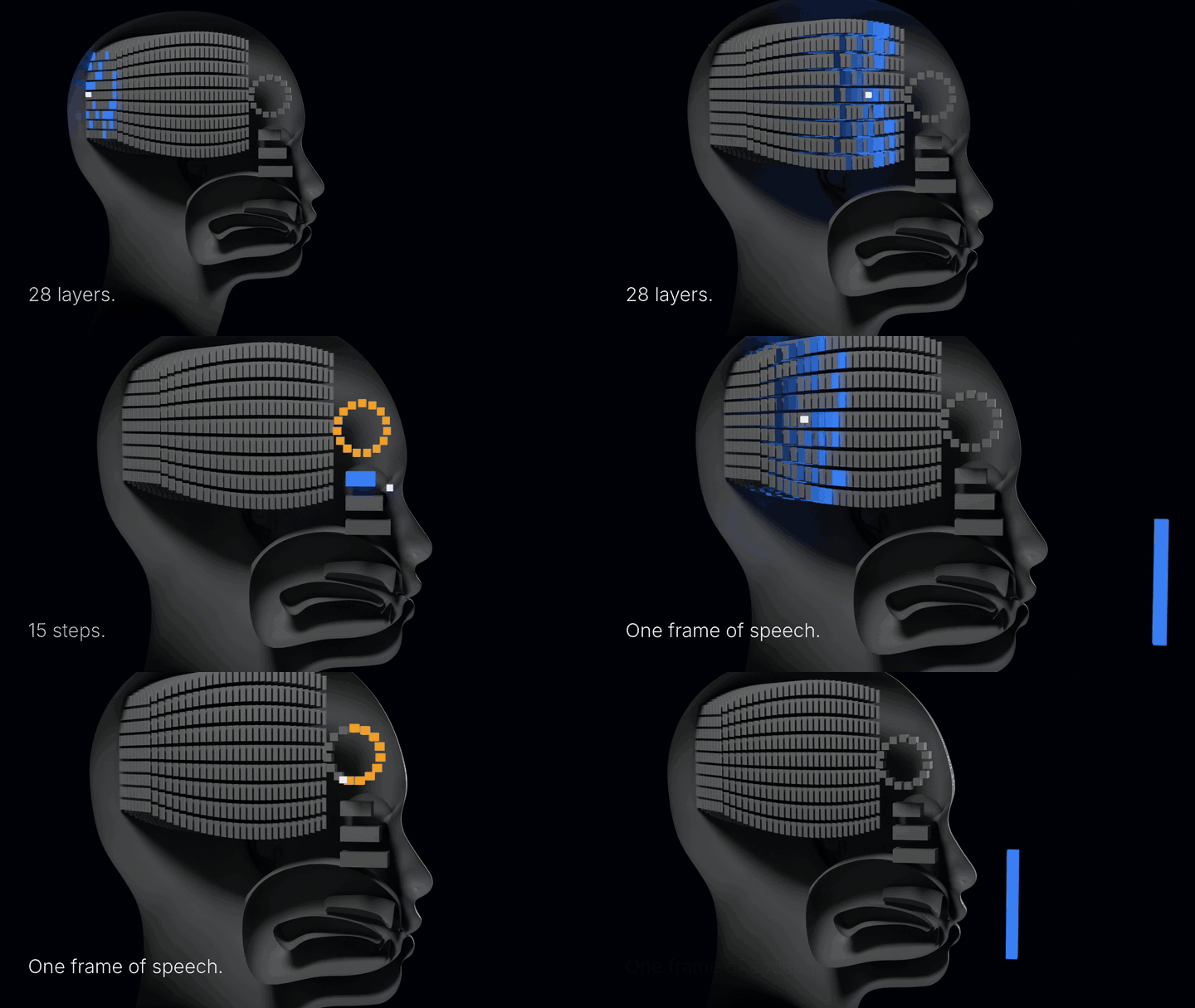
Qwen3-TTS makes speech in two stages that run for every frame. A Talker, a 28-layer transformer, predicts the first code of the frame, and a small code predictor then runs 15 times to fill in the rest. A convolutional codec decoder turns the finished codes into samples. With a single stream, each of those transformer steps reads all of its weights to do very little arithmetic with them, so the time goes to the reads.
Batching spreads the weight reads over many streams, and then the next cost appears. Each stream carries its own cache of keys and values, which is read in full on every step and grows as the clip gets longer, and the codec decoder moves large intermediate tensors through the same memory between its layers. The work below goes after those three in turn.
What does a step read now?
Weights are stored as FP8 with one scale per output channel and dequantized in registers inside Triton kernels, so the tensor-core math stays in BF16 while half as many weight bytes cross the bus. That took a single stream from 28.3 ms per frame to 13.6 ms. For one or two rows the batched kernel is the wrong shape, because it pads every row to 16 for the tensor cores, so single streams use a multiply-reduce kernel on the CUDA cores that reads an FP4 copy of the weights instead. It reads them at 190 to 260 GB/s.
Attention used to pad every stream in the batch to the length of the longest one. It now attends each stream over only its own live keys and values, and those are stored as INT8 with a scale per row, quantized in the same kernel that writes them. On a second GB10, with three servers per format run alternately, the INT8 cache took throughput at 128 clients from 122.4 to 140.0 seconds of audio per second.
The codec decoder is fused where its intermediates were largest. A residual unit runs as one kernel, the activation and transposed convolution that open each block run as one matrix multiply, and the output convolution carries its final activation with it. At 256 streams that took the decoder from 157 to 99 µs per frame of each stream. The code predictor and the streaming decoder started from vLLM-Omni’s open-source versions.
How was it measured?
Every server ran alone on one GB10 with the same multi-process client on the same box, each client sending its next request as soon as the last one finished. vLLM-Omni 0.32 ran its default two-stage profile and sglang-omni 0.2 its Qwen3-TTS config, both at their default limits. sglang-omni needed a one-line patch to start, because one of its Triton kernels asks for more shared memory than the chip’s 99 KiB, and vLLM-Omni’s fused single-GPU profile asks for more still and does not start at all.
vLLM itself does not serve Qwen3-TTS, so vLLM-Omni is the vLLM project’s way to run it. Baseten also serves Qwen3-TTS with vLLM-Omni and reports an executor change it shipped back to the project. We measured the public 0.32 release and not Baseten’s deployment. sglang-omni at 1, 128 and 256 clients and vLLM-Omni were measured two days before the rest, on the same machine.
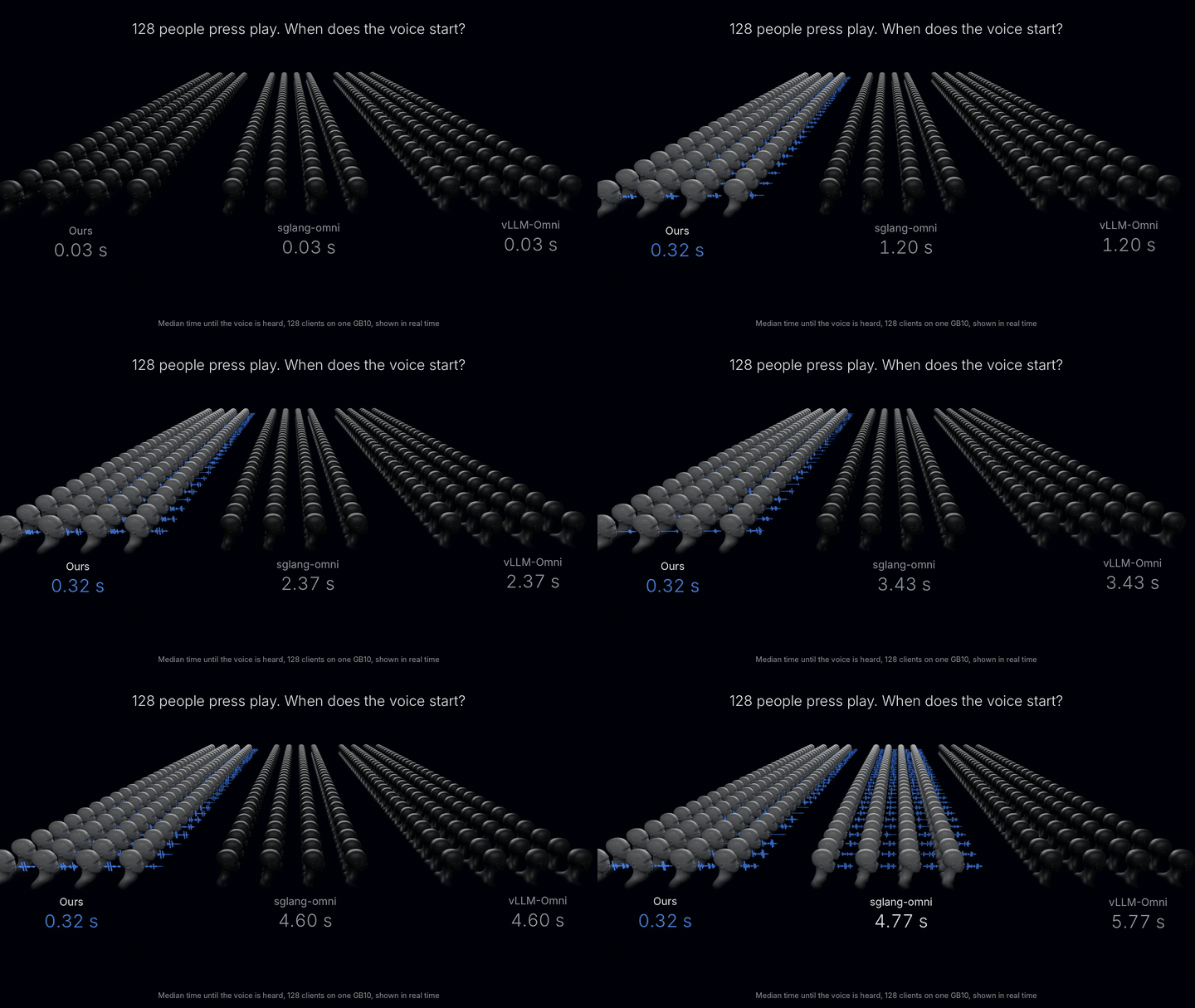
A first byte is not yet a voice, since a server can send a first chunk of silence or stall right after it. So we also measured when a listener hears speech, which is the first byte plus any stall and the silence the clip opens with.
| Clients | Voice, ours | Voice, sglang-omni | Voice, vLLM-Omni | First byte, ours | First byte, sglang-omni | First byte, vLLM-Omni |
|---|---|---|---|---|---|---|
| 1 | 42 | 89 | 873 | 32 | 79 | 56 |
| 8 | 88 | 114 | 1,029 | 78 | 104 | 109 |
| 32 | 104 | 205 | 1,875 | 88 | 94 | 166 |
| 64 | 164 | 260 | 3,146 | 92 | 101 | 267 |
| 128 | 316 | 4,770 | 13,421 | 230 | 4,634 | 10,407 |
| 256 | 415 | 5,114 | 34,292 | 324 | 4,921 | 31,275 |
Does the audio keep up with playback?
This is where the engine was weakest for a while, because at 128 clients about 99% of requests had at least one chunk that arrived after a listener would have needed it. The server held each stream’s audio until a whole chunk was ready, so now a stream’s pending audio goes out early when its listener is about to run dry, which brought that share down to a few percent.
The serving loop had a second problem, a host-to-GPU copy that waited for the step it had just launched, so decoding and admitting requests never overlapped generation. Those copies no longer block, and a request that arrives while a step is running joins the next one.
Requests with a late audio chunk
Percent of requests, lower is better
- Ours
- sglang-omni
- vLLM-Omni
- 8 clients
- 32 clients
- 64 clients
- 128 clients
- 256 clients
At 256 clients generation runs at real time with nothing to spare, so most requests there do have a late chunk, usually by less than a tenth of a second.1
Does it still say the right words?
It says them as well as sglang-omni does. We ran the same 300 LibriSpeech test-clean texts through each system’s own server, 88 times for ours, 48 for sglang-omni and 8 for vLLM-Omni, and scored the audio with Whisper large-v3.
| System | All clips | Without garbled clips | Garbled clips |
|---|---|---|---|
| Ours | 2.34% | 1.92% | 53 (0.20%) |
| sglang-omni | 2.33% | 1.94% | 29 (0.20%) |
| vLLM-Omni | 2.93% | 1.97% | 3 (0.13%) |
Ours is 0.01 points from sglang-omni, with a 95% interval from −0.37 to +0.39, and both garble one clip in 500. Our first test had us 0.50 points behind over 2,400 clips, with 9 garbled against 3, so we ran 24,000 more clips of ours and 12,000 of sglang-omni’s and the gap did not repeat. The first test is included in the table. vLLM-Omni’s sample is too small to separate it from either.
The INT8 cache was checked on its own over 1,500 clips per format, where BF16 scored 2.09% and INT8 1.81%, a difference whose 95% interval runs from −0.62 to +0.01 points. We read that as no loss and no proven gain.
What broke on the way?
With unquantized weights the larger test hung the GPU in its first run. Captured CUDA graphs were sharing one cuBLAS workspace, and two of them replayed at once on different streams could deadlock. Each graph pool now has its own workspace, and default and unquantized weights have each finished 40 runs of 300 clips without a hang. The default setup had not hung before the fix.
The speed figures here were measured before it. Run with and without the fix on another GB10, throughput from 32 to 256 clients differed by −2.2% to +0.7%, and none of the differences was significant.
What didn’t work?
The code predictor launches many small kernels, so we measured a persistent kernel that keeps all of its steps on the GPU. It gained nothing, because replaying the same kernels from a CUDA graph already streams the weights at the bandwidth limit.
GB10 has native FP4 tensor-core instructions, and we wanted to use them. Triton lowers its FP4 dot product on this chip to a software conversion followed by BF16 math, so FP4 only pays off in the CUDA-core kernel for one or two rows. Quantizing the activations to FP8 as well ran no faster than quantizing the weights alone, and had a higher error.
Smaller prefill sizes for short prompts cut the first byte by 4 to 5 ms at 32 to 64 clients. The word error rate was higher in the same test, so they are off.
Where it stands
A GB10 now runs Qwen3-TTS for 128 clients at once at a median real-time factor of 0.64, and all but 7% of those requests play through without a late chunk and without a buffer on the listener’s side. A single voice takes about a third of the time per frame that it did in BF16.
The code, every benchmark and the raw runs are at https://github.com/magni-hq/ultra-qwen3-tts-gb10.
Notes
-
At 256 clients the median real-time factor is 0.98 for ours and 0.84 for sglang-omni, on the 44% of requests it accepted. ↑